Application Scenarios and Principles of Mouse IgG
- 发布时间:2023-10-16
1. Use of mouse IgG products
(1) A blocking agent in immune reactions that blocks the surface of solid phase materials and reduces the non-specific binding of antibodies and antigens.
(2) Blockers in immune reactions that block the non-specific binding of endogenous heterophilic antibodies to antigenic antibodies in the sample to be tested, improving the sensitivity and specificity of the reaction.
(3) Used as an IgG reference substance in some biochemical analysis tests.
(4) As a stabilizer for proteins.
(5) As a reference antigen, it is used to observe immune effects in drug trials.
2. Application scenarios and principles of mouse IgG
As a blocking and blocking agent in immune response, mouse IgG is suitable for almost all immune detection and analysis, including enzyme-linked immunosorbent assay, lateral flow immunochromatography, chemiluminescence immunoassay, protein immunoblotting, colloidal gold immunochromatography, etc. It is a universal raw material in the field of IVD and is widely used in disease diagnosis kits, test strips, medical testing, laboratory analysis, and other scenarios.
The specific application scenarios of mouse IgG mainly include the following aspects:
(1) Immunodiagnostic reagents
Mouse derived IgG is used as an immunoassay reagent. By binding specific antibodies to mouse IgG, the presence of target proteins in the sample can be detected and their quantity determined.
Application scenarios: ELISA, Western blotting, immunohistochemistry and other antigen detection
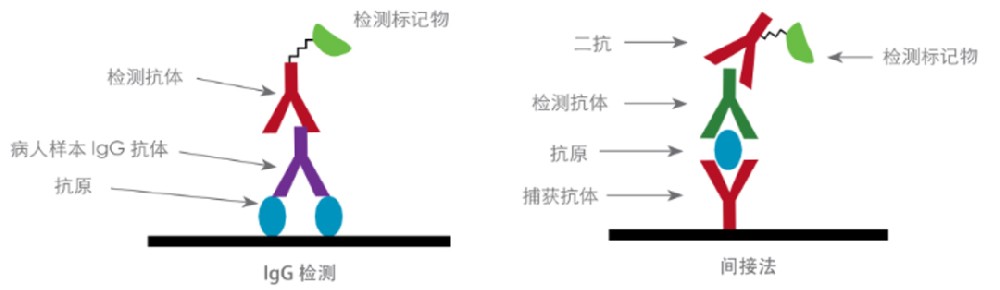
Principle: As labeled antibodies, unlabeled detection antibodies and labeled secondary antibodies (indirect detection) that match the detection antibodies (direct detection) or a set of matched unlabeled detection antibodies are used to detect antibodies in patient samples.
(2) Blocking agent, sealing agent
In some immune response experiments, background signals can interfere with the required accuracy of results. Researchers use mouse IgG to eliminate this background signal. Mouse IgG binds to non-specific receptors and other components, thereby reducing background signals and blocking the interference of non-specific components in the detection; In addition, mouse IgG can be used for binding sites on the surface of saturated solid phase materials that are not coated by antibodies, thereby preventing non-specific binding of the detected substance and sealing the solid phase surface.
Application scenarios: ELISA, colloidal gold, immunofluorescence, disease diagnosis kits;
Principle: In immune diagnostic testing, there is often non-specific interference that affects the accuracy of the test results. This non-specific binding can occur in
a. Binding of solid phase materials to non target proteins or
b. The binding of endogenous detection antibodies present in the sample to be tested and antibodies in the detection reagent.
To prevent non-specific binding, a blocking agent is used to block the remaining unbound sites on the solid phase material after being coated. During the preparation of the test sample, a blocking agent is used to block the binding of endogenous interfering antibodies to the test reagent antibody, thereby improving the sensitivity and specificity of the test and avoiding false positive or false negative results.
The unbound impurities in the sample, such as proteins, interfering molecules, and measurement markers, bind to the surface of the solid phase material and compete with specific antigen antibody reaction signals, resulting in background noise and reduced detection signals.
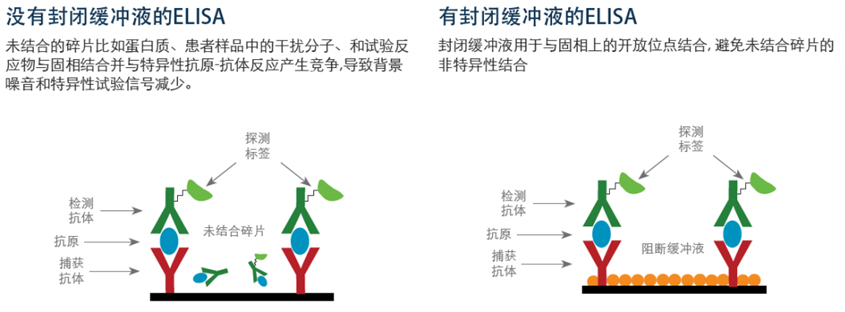
The closed buffer can encapsulate the open sites on the solid phase material to prevent non specific binding of unbound impurities to the open sites. As an ideal sealing agent, mouse IgG can effectively block hydrophobic and hydrophilic sites on the surface of solid phase materials. On the other hand, it can serve as a stabilizer to prevent protein denaturation during surface reactions with solid materials.
Ideal sealing agents have the following characteristics:
a. Effectively blocking the non-specific binding of reactants to the surface of solid materials;
b. It does not affect the active components of the reagent that have been coated on the surface of the solid material, and can serve as a stabilizer (preventing denaturation) for the active components of the reagent on the solid surface;
c. No cross reaction with other active ingredients of reagents;
d. Does not have enzyme activity and may therefore react with substrates in the reagent, resulting in signal enhancement or degradation of reactants in the reagent;
e. The difference between batches is small for each batch number.
In immune testing, there are usually multiple endogenous interfering substances in patient samples, mainly heterophilic antibodies (HA), human anti mouse antibodies (HAMA), and rheumatoid factors (RF). They reduce the sensitivity and specificity of the test by non-specific binding or weak cross reactivity with the test antibody, leading to false positive or false negative results.
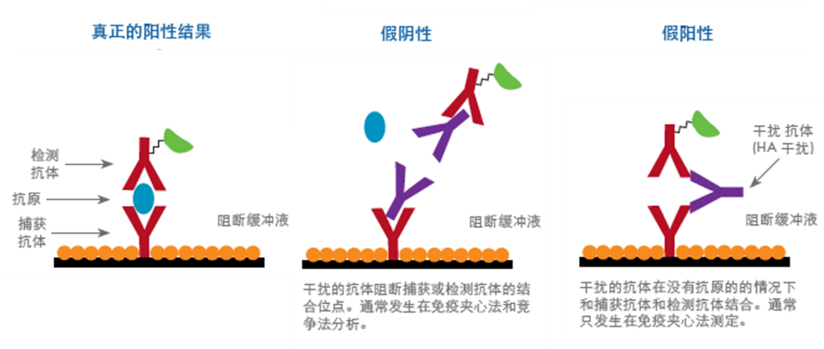
Double antibody sandwich antigen detection, competition method, and lgM capture detection are all susceptible to endogenous interference. Therefore, in order to improve the accuracy and specificity of immune diagnostic testing, it is essential to use specialized immune blocking agents to reduce the erroneous results caused by these non-specific interferences.
(3) Flow cytometry sorting:
Mouse derived IgG is commonly used in flow cytometry to distinguish different cell types and surface markers. It can:
Labeling target cells: In flow cytometry experiments, researchers typically select one or more highly specific fluorescein or dyes that bind to mouse derived IgG, such as FITC, PE, APC, etc., and bind them to mouse derived IgG for labeling target cells.
b. Differentiation of target cells (immunodiagnosis): After labeled mouse IgG fluorescein or dye is bound to the surface markers of the target cells, flow cytometry can distinguish different target cells and their surface markers based on the excitation and emission wavelengths of the corresponding fluorescein or dye when scanning the cells.
c. Reduce non-specific binding (blocking agents): Mouse derived IgG will interact with other components in the flow cytometry kit and Fc on the cell membrane through its Fc receptor γ Receptor binding reduces non-specific binding, making formal experimental results more reliable.
(4) Control mouse IgG:
Used as a control IgG for mouse specific antibodies in antibody related experiments such as immunoprecipitation, immunoco precipitation, chromatin immunoprecipitation, immunohistochemistry, immunofluorescence, immunoblotting, etc.